

Click Image To Return To Hub Main Page
-
Companies Mentioned on this website and other spaces maintained by Perspective Reports are not affiliated with Perspective Reports Unless otherwise stated. All for educational and entertainment purposes unless otherwise stated.

World Of American Football
Background
World Of American Football
The early 2000s established the young male consumer as an unprecedented financial force that fundamentally reshaped the media and tech industries. This era saw the meticulous construction of an entertainment ecosystem centered on themes of action, competition, and cutting-edge digital experiences. Blockbusters like Spider-Man (2002) launched the modern superhero dominance, signaling massive cinematic investment, while the heated PlayStation 2 vs. Xbox console wars fueled billions in hardware and software sales, cementing gaming as a mainstream powerhouse. Beyond the screens, franchises like Yu-Gi-Oh! translated digital excitement into a booming collectible market, selling over 22 billion cards and proving the financial viability of fostering collection habits. Simultaneously, the rise of Tony Hawk’s Pro Skater and titles like Madden NFL drove hundreds of millions into extreme sports apparel, licensed merchandise, and early tech adoption. Collectively, this content was a powerful economic engine that commanded global investment and set the consumption trends for the digital generation.
Country Of Origin: USA
Years Active Originated: 2025
The Art of Deception
An Analysis of the Trick Play in Modern Football
The High-Stakes Gambit
In a game of inches, a single moment of deception can change everything. Trick plays are football's ultimate high-risk, high-reward strategy, designed to exploit a defense's assumptions and create explosive gains. While standard offensive plays are the bedrock of any game plan, the unexpected playcall can be the key to victory.
Average Yards Per Play
on Trick Plays
Average Yards Per Play
on Standard Plays
This stark difference highlights the explosive potential of a well-executed trick play. By catching the defense off-guard, teams can generate more than double the yardage of a typical play.
Risk vs. Reward: The Statistical Edge
While the yardage is enticing, trick plays carry significant risk. To quantify this, we compare the average Expected Points Added (EPA) and turnover rates for trick plays versus standard offensive plays. EPA measures a play's impact on the score, while the turnover rate shows the risk of losing possession.
As the chart shows, the potential upside in EPA for a trick play is massive—often more than ten times that of a standard play. However, this comes at the cost of a much higher turnover probability. Coaches must weigh this gamble in critical game situations.
Trick Play vs. Standard Play
The Deception Playbook
Not all trick plays are created equal. The most common forms rely on misdirection, with flea flickers, reverses, and throwback passes to non-traditional throwers being the most popular categories in the modern NFL.
When to Strike: Success by Down
Timing is everything. Trick plays are most effective when the defense least expects them. Data suggests they have the highest success rate on 1st down, when defenses anticipate a standard run or pass, and on 4th down, when the element of surprise is absolute.
Case Study: The "Philly Special"
Perhaps the most famous trick play in modern history, the "Philly Special" from Super Bowl LII, perfectly encapsulates the strategy. On 4th-and-goal, the play involved multiple handoffs and a pass from a tight end to the quarterback for a touchdown. It was a high-risk call that relied on flawless execution and pure audacity.
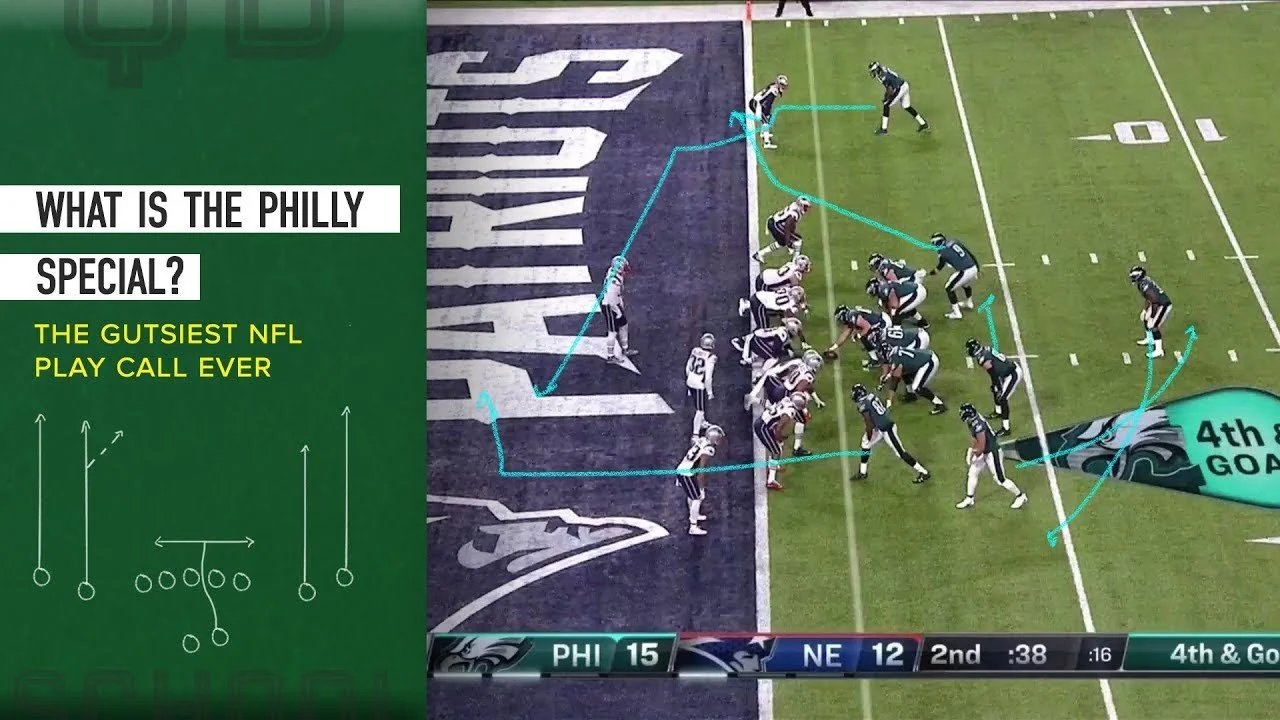
QB Foles motions out, snap goes to RB Clement.
Clement pitches to TE Burton running a reverse.
Foles slips into the end zone, Burton throws the pass.
Foles catches the pass, securing a critical score.
The Modern Trend: A Growing Gambit
Contrary to what some might think, the trick play is not just a relic. Analysis of playcalling data over the last decade shows a slow but steady increase in the number of trick plays attempted per season, particularly in high-leverage situations like the playoffs and red zone.
This trend suggests that as defenses become more sophisticated, offenses are increasingly turning to deception to create an edge. The rise of creative, analytics-driven coaches has further emboldened teams to add these high-variance plays to their arsenal.
EXTRA VISUALS!
Perspective Reports Content
Featuring American Football
Sources And Links To More Information: