

Click Image To Return To Hub Main Page
-
Companies Mentioned on this website and other spaces maintained by Perspective Reports are not affiliated with Perspective Reports Unless otherwise stated. All for educational and entertainment purposes unless otherwise stated.
Magazine Industry
Background
Magazine Industry
The Following is a collection of relevant data points from reputable sources about Halloween around the world scroll down for more!
Country Of Origin: Globe
An Industry in Transition
The Rise, Cultural Impact, and Digital Disruption of the Magazine Industry
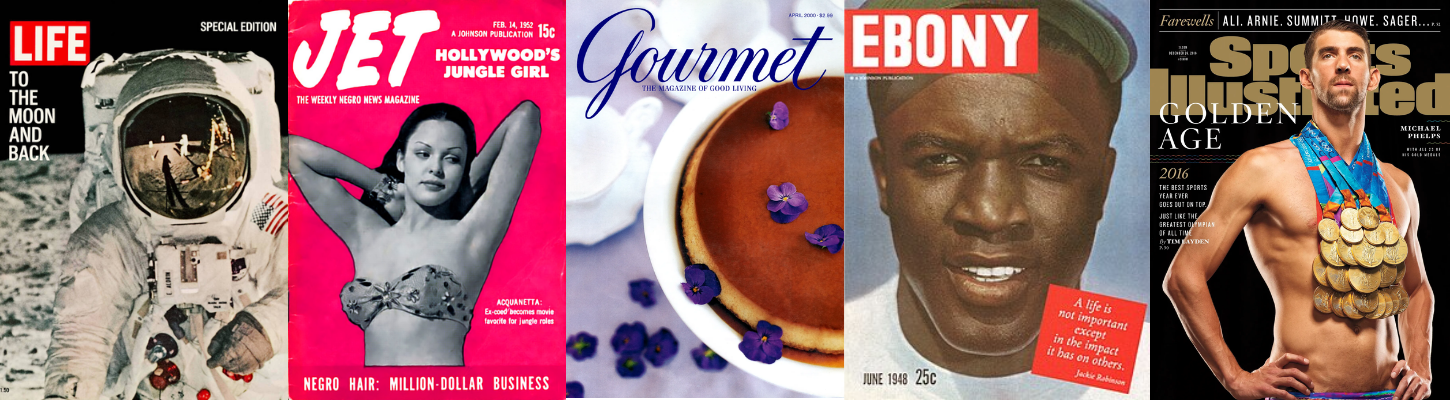
From setting cultural agendas to driving national conversations, magazines were once the undisputed titans of media. Titles like Life, Ebony, and Sports Illustrated did more than just report; they shaped the very identity of the 20th century. This infographic explores their financial and cultural zenith, the key strategies that defined their eras, and the stark financial realities of the digital disruption that has led to a dramatic industry contraction.
The Great Revenue Shift
The core business model of the magazine industry, built on high-margin print advertising, has been fundamentally broken by the internet. While digital ad revenue has grown, it has failed to compensate for the precipitous drop in print, creating a massive, often fatal, revenue gap.
From Print to Pixel: An Industry Timeline
1741: The Dawn
First American magazines appear in Philadelphia, setting the stage for a new form of media.
1890s-1920s: Mass Circulation
Lower printing costs and national advertising create the first mass-market magazines.
1936: The Photojournalism Era
Life Magazine launches, defining photojournalism and becoming a weekly cultural fixture in America.
1945: A New Voice
Ebony Magazine is founded by John H. Johnson, creating a positive, aspirational platform for Black Americans.
1951 & 1954: Niche Titans
Jet (1951) and Sports Illustrated (1954) launch, proving the power of targeted, weekly content.
1972: The First Giant Falls
Life ceases weekly publication, a victim of high costs and direct competition from television advertising.
1995: The Web Arrives
The launch of websites like Salon and the rise of the commercial internet begin the slow erosion of print's dominance.
2009: The Recession's Victim
Condé Nast shutters Gourmet Magazine, signaling that even affluent, niche audiences are not immune to ad market collapse.
2014-2019: The Digital Culling
Jet ceases print (2014), and Ebony files for bankruptcy (2019), marking the end of an era for Johnson Publishing.
2024: The Brand Implosion
Sports Illustrated's staff is gutted after a licensing model fails, highlighting the perils of brand dilution.
Titans of Culture: Ebony & Jet
For decades, Johnson Publishing's Ebony and Jet were more than magazines; they were essential institutions. They chronicled Black life, culture, and civil rights with a depth and respect unseen in mainstream media, creating a powerful, loyal readership and a highly lucrative, targeted advertising market. Their cultural impact was immeasurable, shaping narratives and inspiring generations.
Peak Paid Circulation (Millions)
The Generalists: Life & Gourmet
Life pioneered visual storytelling, its high-production costs financed by massive ad sales. Its downfall was television, which stole its mass-market audience and ad dollars. Gourmet catered to a luxury, niche audience, making it a profitable venture until the 2008 financial crisis decimated its luxury ad base, proving that niche quality alone was not a sustainable model.
Primary Closure Factors for Print Titans
Deep Dive: Sports Illustrated
Launched by Time Inc. in 1954, Sports Illustrated (SI) evolved from a leisurely sports magazine into a journalistic powerhouse. It redefined sports reporting with long-form writing, unparalleled photography, and a weekly cadence that captured the drama of sports. Its cultural dominance was cemented by its iconic covers, which became a measure of athletic greatness, and the Swimsuit Issue, a controversial but colossally profitable brand extension that, at its peak, generated an estimated 7% of Time Inc.'s annual revenue.
Financially, SI was a cash cow, leveraging its brand into books, TV specials, and merchandise. However, it was slow to adapt to the 24/7 digital sports news cycle dominated by ESPN and later by social media. After being sold by Time Inc., its new ownership pursued a risky licensing strategy. This culminated in a 2024 debacle where the operating license was revoked, leading to mass layoffs and the potential end of the magazine as a credible entity, a stark lesson in mismanaging a legendary brand.
Hypothetical Brand Analysis (2024)
This radar chart visualizes the current state of the SI brand. While Brand Recognition remains perfect, its Digital Strategy and Ad Revenue have collapsed. Decades of Journalism excellence built immense Reader Trust, but recent strategic failures have critically wounded the institution, showing a brand strong in legacy but failing in execution.
The Great Strategic Pivot
The shift from print to digital required a complete reinvention of the business model. The old model was simple and profitable; the new model is fragmented, complex, and far less lucrative.
Traditional Print Model
Core Revenue
Print Advertising (High CPMs) & Subscriptions
Content Cycle
Weekly or Monthly (Long Lead Times)
Key Costs
Printing, Paper, Distribution, Large Editorial Staffs
Strategy
Build a large, loyal subscriber base to attract premium brand advertisers.
Modern Digital Model
Core Revenue
Programmatic Ads (Low CPMs), Paywalls, E-commerce, Licensing, Events
Content Cycle
24/7/365 (Immediate, High Volume)
Key Costs
Content Creation, Platform Tech, Audience Acquisition (SEO/Social)
Strategy
Diversify revenue streams, engage audience on all platforms, and convert casual readers to paying members.
The Human Cost: Newsroom Collapse
The financial decline is not just about numbers; it's about the decimation of the journalistic workforce. The chart below shows the dramatic decline in newsroom employment, representing a massive loss of institutional knowledge and investigative capacity.
Current Trends & Fading Reality
The magazine industry is now a shadow of its former self. The few remaining legacy titles are shells, often owned by investment firms or brand licensing companies. The "fading" is not a prediction; it is the current reality.
- Brand Licensing: The final frontier, where the magazine's name is licensed to produce products, often with little connection to the original (e.g., SI-branded supplements).
- The "Pivot to AI": A controversial and often-failed strategy to replace human journalists with AI-generated content, leading to reader backlash and brand erosion.
- Hyper-Niche Paywalls: Small, independent, subscription-based publications (e.g., Substack) are thriving, suggesting a future for focused, high-quality content, but not for mass-market media.
- Event-Based Models: Using the brand name to host high-margin conferences, festivals, and events, turning the "magazine" into a marketing arm for an events company.